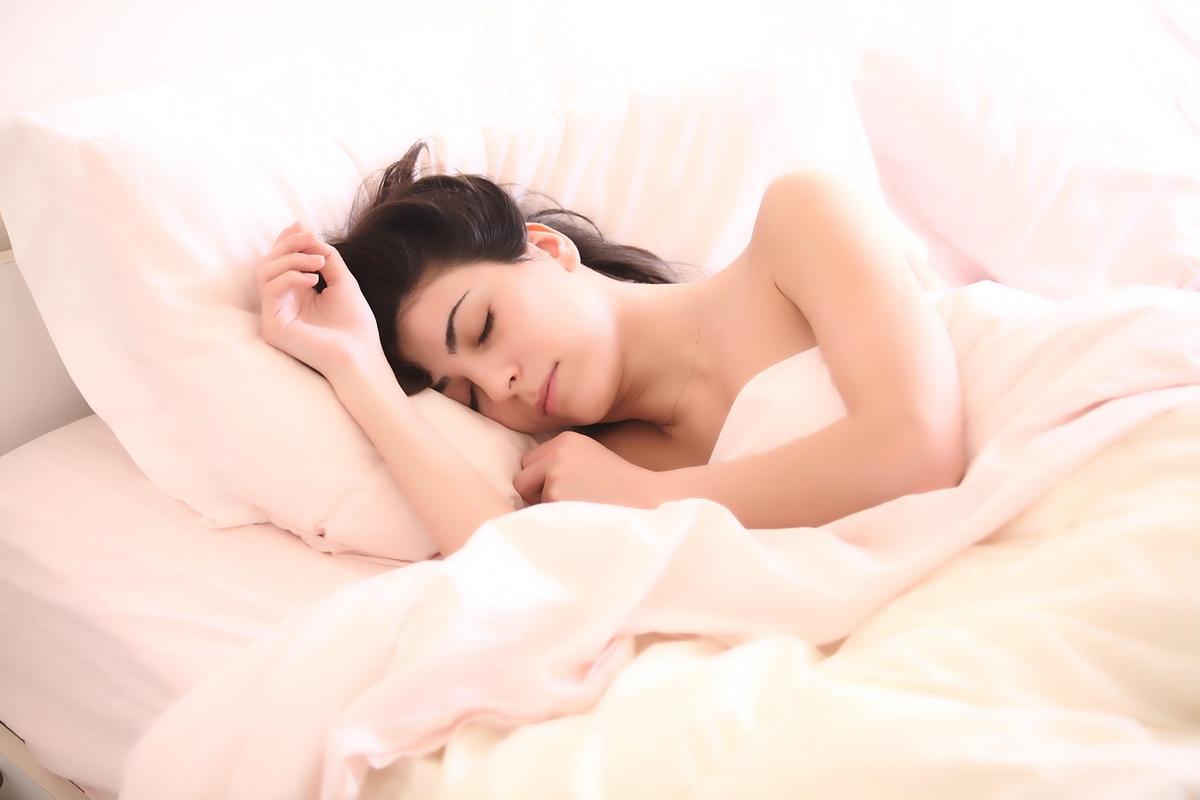
The short version
- As you fall asleep, your body temperature drops. A cool bedroom helps your body shed heat faster — and fall asleep faster too.
- Most adults sleep best between 18–22 °C (64–72 °F). Higher temperatures shorten sleep and reduce deep sleep.
- A warm bath or shower 1–2 hours before bed speeds up sleep onset: your body heats up, then actively releases heat through the skin.
- Heat mostly cuts into deep sleep — the part of the night that restores you physically.
- In summer, blackout curtains during the day, ventilating after sunset, and lightweight bedding all help.
The best temperature for sleep is one of the few things that's easy to change and genuinely affects the quality of your night. No new habits, no supplements. Just getting the conditions in your bedroom right.
Why temperature affects sleep
When you fall asleep, your brain doesn't just switch off — it runs a precise physiological sequence. One of its key steps is a drop in core body temperature. The hypothalamus controls both sleep and thermoregulation: these two processes are deeply linked, and when one starts, the other shifts too [1] [2].
As you approach sleep, blood vessels in your hands and feet dilate. Heat escapes from the skin surface, and your core cools down. Research shows that this outward heat flow is the single best predictor of how quickly you'll fall asleep — better than core temperature itself or melatonin timing [3].
Non-rapid eye movement (NREM) sleep — including deep sleep — is accompanied by cooling not just in the body, but in the brain itself [1]. A warm bedroom interferes with this: the body can't cool down properly, and the transition into deep sleep is harder to reach.
Body temperature also follows a daily rhythm: it starts falling in the late afternoon, hits its lowest point around the middle of the night, and rises again before waking — that rise is part of what pulls you out of sleep. This cycle is controlled by the same hypothalamic clock that regulates melatonin [2]. When bedroom heat disrupts this decline, sleep becomes shallower even if you're in bed for enough hours.
For more on how sleep recovery works in general, see how to fix your sleep schedule.
What bedroom temperature is best for sleep
There's no single magic number — the ideal temperature depends on your age, clothing, and bedding. But research points to a consistent range.
In a longitudinal study that tracked both bedroom temperature and sleep quality in adults over an extended period, sleep was most efficient and restful when the room stayed between 20 and 25 °C (68–77 °F). When temperature climbed from 25 °C to 30 °C (77–86 °F), sleep efficiency dropped by 5–10% [4].
A separate observational study that used wrist actigraphy and in-room sensors found sleep efficiency was 3.4% lower in bedrooms with the highest temperatures compared to the coolest ones [5].
The Sleep Reset program recommends keeping the bedroom at 17–21 °C (63–70 °F) with humidity between 30–50%. Cool enough to help the body shed heat, but not so cold you're burning energy to stay warm. If you sleep under a duvet, the upper end of that range works well; with warmer pajamas, the lower end is fine.
Older adults tend to be more sensitive to nighttime heat. A 2025 study found that in adults over 65, the odds of autonomic disruption — a sign of physiological stress — were 1.4 times higher at 24–26 °C compared to below 24 °C, and nearly 3 times higher at 28–32 °C [11].
Children and pregnant women may also respond to heat more strongly than average [8].
Does clothing matter? Yes. In warm pajamas under a heavy duvet, your body creates its own microclimate — so the room can be a few degrees warmer. If you sleep without pajamas or under just a light sheet, aim for the cooler end of the range, around 17–19 °C (63–66 °F). There's no universal rule: comfortable is correct.
What happens when the bedroom is too warm
Heat at night isn't just uncomfortable. It shortens sleep and changes its structure.
In an experiment comparing bedroom conditions of 27 °C versus 30 °C (81 vs. 86 °F) in older adults, the warmer condition reduced total sleep time by 26 minutes, sleep efficiency by 5.5%, REM sleep by 5 minutes, and increased time spent awake during the night by 27 minutes [6].
A large-scale observational study — 23 million nights of data from more than 214,000 participants — found that for every 10 °C (18 °F) rise in average nighttime temperature, the odds of insufficient sleep increased by 20.1% and total sleep time decreased by 9.7 minutes. Deep sleep was the hardest hit, declining by 2.8% [7].
Deep sleep is responsible for physical recovery. How it works and why getting less of it feels so noticeable — see deep sleep: how much you need and how to get more.
Poor ventilation makes things worse. CO₂ buildup in a stuffy bedroom independently reduces sleep efficiency, and the effects of heat and poor ventilation stack on top of each other [6].
A warm shower or bath before bed
It sounds counterintuitive — heat yourself up to cool down? But that's exactly how it works.
When you take a warm shower or bath, blood flow to your hands and feet increases, heat escapes through the skin, and your core temperature drops faster than it would otherwise. The result: you fall asleep more quickly.
A 2019 meta-analysis covering 17 studies found that bathing in 40–42.5 °C (104–109 °F) water for at least 10 minutes, 1–2 hours before bed, improved self-rated sleep quality, sleep efficiency, and shortened sleep onset latency [9].
A large cohort study of 1,094 older adults confirmed this: a hot bath taken 61–180 minutes before bedtime was linked to significantly shorter time to fall asleep, both by actigraphy and self-report [10].
Timing matters. Bathing right before bed is less effective — the body needs time to cool down after. The sweet spot is 1–2 hours before you plan to sleep.
No bathtub? A shower works. Even soaking your feet in warm water triggers the same heat-release mechanism through the peripheral vessels [3].
How to cool your bedroom
Ventilate in the evening, when outdoor air is cooler than inside. In a heatwave, keep windows and curtains closed during the day — more heat comes through glass than through walls — then open everything after sunset.
Blackout curtains or roller shades make a real difference in summer. If you have air conditioning, turn it on 30–40 minutes before bed so the room reaches the right temperature before you lie down.
Choose light bedding made from natural fabrics. Cotton and linen wick moisture better than synthetics. On hot nights, ditch the duvet and use just a sheet.
Stick your feet out from under the covers. Your feet and palms are the body's main "radiators" — they release more heat per square inch than anywhere else. Even thin socks can help by improving peripheral blood flow and heat loss [1].
Remove heat-generating devices from the bedroom: chargers, large monitors, old televisions. Small sources, but noticeable in a small room.
Sleeping with a partner who runs warmer or cooler than you? Separate duvets at the same room temperature is the simplest fix — each person controls their own microclimate without negotiating the thermostat.
For sleep hygiene tips more broadly, see sleep hygiene: rules and what the science says.
When it's hot outside
Hot nights deserve their own strategy. The European Insomnia Network published practical recommendations specifically for heatwave conditions [8].
Cool your body directly. A cool (not ice cold) shower before bed lowers skin temperature. Cool your wrists and neck — areas with large blood vessels close to the surface. A cool compress on your forehead or the cool side of your pillow both help.
Drink water before bed. Heat increases fluid loss, and even mild dehydration adds physiological strain overnight.
If your air conditioner is noisy, cool the room before bed instead of running it all night. Turn it on an hour or two before sleep, bring the room down to around 20–21 °C (68–70 °F), then turn it off. The room will hold that temperature for a few hours — long enough to get through the deepest part of your sleep. Or use a timer so it switches off automatically.
Don't worry yourself into sleeplessness. Anxiety about not sleeping in the heat adds more arousal than the discomfort itself. One hot night is not a disaster. If you want general help falling asleep faster in any conditions, see how to fall asleep fast.
Temperature in the Sleep Reset program
On Day 1 of the program, "Synchronization," the opening lecture covers the core rules of sleep hygiene — including bedroom temperature: 17–21 °C (63–70 °F), humidity 30–50%. These conditions help the body complete the temperature drop needed to enter deep sleep.
The "SCN Signal" practice on Day 1 uses morning light exposure to synchronize circadian rhythms. That synchronization affects when, in the evening, your body temperature starts declining — which in turn determines how naturally sleep arrives.
Throughout the program, the journal tracks how restorative each night feels. A cool bedroom is one of the factors that influences this quietly, without extra effort.
Sources
- Harding E. C., Franks N. P., Wisden W. The Temperature Dependence of Sleep. Frontiers in Neuroscience, 2019.
- Szymusiak R. Body temperature and sleep. Handbook of Clinical Neurology, 2018.
- Kräuchi K., Cajochen C., Werth E. et al. Functional link between distal vasodilation and sleep-onset latency? American Journal of Physiology, 2000.
- Baniassadi A., Manor B., Yu W. et al. Nighttime ambient temperature and sleep in community-dwelling older adults. Science of the Total Environment, 2023.
- Basner M., Smith M. G., Jones C. W. et al. Associations of bedroom PM2.5, CO2, temperature, humidity, and noise with sleep. Sleep Health, 2023.
- Yan Y., Zhang H., Kang M. et al. Experimental study of the negative effects of raised bedroom temperature and reduced ventilation on the sleep quality of elderly subjects. Indoor Air, 2022.
- Li A., Luo H., Zhu Y. et al. Climate warming may undermine sleep duration and quality in repeated-measure study of 23 million records. Nature Communications, 2025.
- Altena E., Baglioni C., Sanz-Arigita E. et al. How to deal with sleep problems during heatwaves: practical recommendations from the European Insomnia Network. Journal of Sleep Research, 2023.
- Haghayegh S., Khoshnevis S., Smolensky M. H. et al. Before-bedtime passive body heating by warm shower or bath to improve sleep: A systematic review and meta-analysis. Sleep Medicine Reviews, 2019.
- Tai Y., Obayashi K., Yamagami Y. et al. Hot-water bathing before bedtime and shorter sleep onset latency are accompanied by a higher distal-proximal skin temperature gradient in older adults. Journal of Clinical Sleep Medicine, 2021.
- O'Connor F. K., Bach A. J. E., Forbes C. et al. Effect of nighttime bedroom temperature on heart rate variability in older adults: an observational study. BMC Medicine, 2025.